
S3-compatible Storage
Presigned uploads, private prefixes, image processing, and MIME validation.
Auth, billing, teams, transactional email, and analytics are already wired into Next.js 16. Built-in agent skills help your coding agent extend and ship.
Built with the best tech on the market
SyntaxKit combines Better Auth with a database-enforced organization layer for invitations, seat limits, permissions, and ownership safeguards.
Stripe handles payment while SyntaxKit keeps subscription state and feature access synchronized across your app.
Use one chat interface across OpenAI, Anthropic, and Google while every response streams through the same application layer.
oRPC, TanStack Query, and Zod share one contract across every layer, keeping inputs, responses, and errors validated and inferred without hand-written API plumbing.
SyntaxKit ships with scoped skills for auth, billing, email, data, and deployment, so your agent can extend the product without rediscovering its architecture.
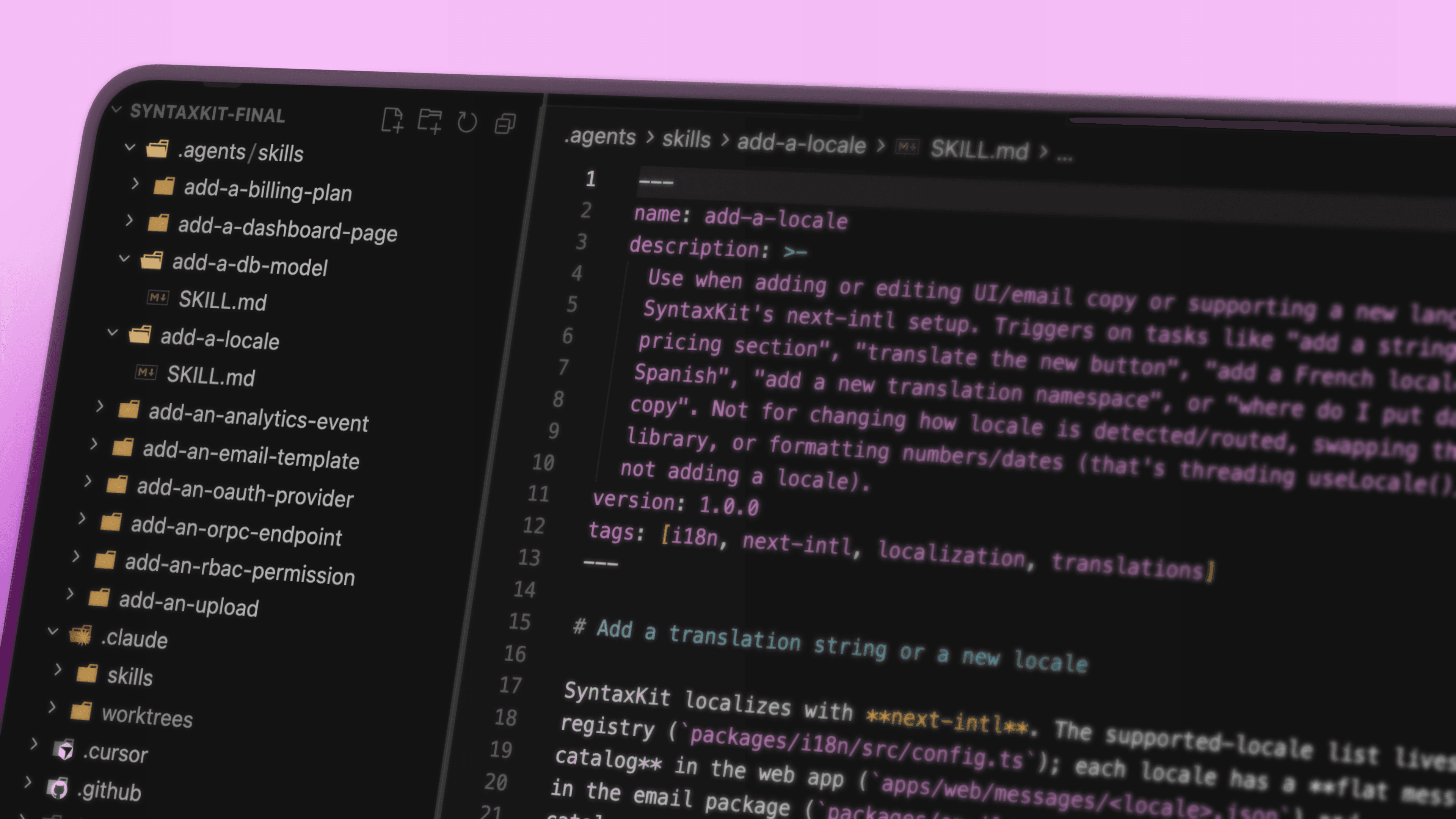
Scoped skills explain where features belong before your agent changes code.
Auth, billing, teams, email, and deployment follow the kit’s existing patterns.
Each workflow defines the checks that prove an implementation is complete.
Add project-specific guidance as your product and conventions evolve.
A production SaaS needs more than its headline features. SyntaxKit wires the operational and platform work too, so you can stay focused on your product.
Presigned uploads, private prefixes, image processing, and MIME validation.
React Email templates with pluggable delivery through Resend, Postmark, SMTP, and more.
next-intl with English, German, and localized URL routing configured from the start.
Typed PostHog events, OpenTelemetry tracing, structured logs, and health probes.
Upstash sliding windows per surface, plus Turnstile protection for exposed forms.
Manage users, roles, bans, and active sessions without building a separate control plane.
Shared packages, pnpm workspaces, and dependency-aware caching across the monorepo.
GitHub Actions for linting, types, tests, browser checks, and container images.
A Fumadocs-powered documentation application that is ready to make your own.

Hey, I’m Jan. For the past few years, I’ve taught Next.js through SyntaxPath to a community of more than 55,000 developers who want to ship real products.
Across tutorials, client work, and my own SaaS products, I kept rebuilding the same auth, billing, multi-tenancy, and AI foundations. SyntaxKit is the production architecture I wish I had on day one, packaged so you can start with your product instead of months of plumbing.
Jan Marshal
The first demo comes quickly. Making it secure, observable, and ready for paying teams is where the months disappear. SyntaxKit starts where most starter kits stop.
Build it yourself
≈ 1,000 hours before you return to the product.
Week 1
Sessions, required email verification, password reset, and account recovery.
Week 2
GitHub, Google, callbacks, and duplicate-account protection.
Week 3
TOTP, backup codes, WebAuthn, and secure recovery flows.
Week 4
Tenant scoping, role hierarchy, and permission checks across every request.
Week 5
Invites, plan limits, role changes, and last-owner protection.
Week 6
Products, prices, trials, tax, and customer self-service.
Week 7
Event deduplication, side-effect keys, retries, and ordering.
Week 8
Trials, grace periods, upgrades, downgrades, and feature gates.
Week 9
Validated procedures, middleware, typed errors, and client inference.
Weeks 10–11
Model gateway, persisted messages, attachments, and web search.
Week 12
Usage ledgers, plan caps, and limits per user and organization.
Month 3
It feels 80% complete. It isn’t. Everything users never see is still missing.
Weeks 13–14
Authorization audits, CSRF, secrets, headers, and dependency review.
Week 15
Rate limits, bot protection, payload bounds, and input validation.
Weeks 16–17
Automated checks, migrations, container builds, and rollbacks.
Week 18
Environment isolation, preview deployments, and representative test data.
Weeks 19–20
Structured logs, traces, alerts, health probes, and on-call context.
Week 21
Templates, provider fallbacks, deduplication, and deliverability.
Week 22
Signed uploads, private prefixes, MIME checks, and image processing.
Week 23
Admin tooling, internationalization, session revocation, and bans.
Weeks 24–26
Audit logs, privacy workflows, documentation, runbooks, and cleanup.
Six months later
You shipped infrastructure instead of learning from users.
With SyntaxKit
Recommended≈ 4 hours to a production-ready foundation.
Hour 1
Hour 2
Hour 3
Hour 4
Day one, live
Six months ahead.
Use the time to build what customers actually pay for.
Choose the license that matches your team and the products you ship. Every plan is a one-time purchase with the full source code and a 30-day refund.
See everything shipped so farOne developer. Unlimited products you own.
A small product team building under one organization.
For studios and agencies delivering products to clients.
No plan requires attribution. Agency adds client-delivery rights; Solo and Studio cover products you or your organization own.
Licensing, updates, support, and what happens after you buy.
Can’t find what you’re looking for? Contact our support team.
Can’t find what you’re looking for? Contact our support team.
Skip the auth, billing, multi-tenancy, AI, and operational plumbing. Own the production foundation and spend your time on the product only you can build.
Licenses from $199 · one-time payment
A full money-back guarantee if it is not the right fit.
New modules and compatibility releases are included.
No subscription, remote lock-in, or required attribution.